



How to Stop Waste? A Major Industrial Challenge
In a context where every wasted minute, every unnecessary movement, or every poorly managed stock directly impacts performance and profitability, the fight against waste has become an absolute priority in industry.
But how can you move from an intention to improve to concrete results on the shop floor? The answer lies in three words: implement visual management.
A true pillar of Lean Manufacturing, it transforms production areas into intelligible spaces, where every anomaly becomes visible, every deviation detectable, and every action prioritized. The benefits of visual management are then easy to understand thanks to the visual controls that it enables.
Let’s discover together how this simple yet remarkably effective approach helps sustainably reduce waste and optimize industrial performance.
What Are the 7 Lean Wastes to Eliminate?
The 7 Types of Muda to Fight
Lean Manufacturing identifies 7 main types of waste (Muda) to eliminate:
- Overproduction: producing too much or too early
- Excess inventory: unnecessary raw materials, work-in-progress, or finished goods
- Motion: unnecessary movements by operators
- Transportation: transfers with no added value
- Waiting: idle time due to flow disruptions
- Overprocessing: non-essential or poorly sized tasks
- Defects: non-conformities leading to rework or scrap
A Direct Impact on Industrial Performance
These wastes generate:
- Hidden costs
- Delivery delays
- Loss of productivity
- Team demotivation
Visually identifying them is the first step toward operational excellence.
Visual Management: A Powerful Lever to Reduce Waste
Making the Invisible Visible
Visual management consists of displaying essential information in the work environment in a clear, quick-to-read, and universally understandable way.
The goal? Detect deviations immediately, without the need for a report or software.
Examples :
- Clearly defined storage areas
- Real-time performance indicators displayed
- Color codes to identify urgencies
- Workstation standards displayed
An Immediate Response to Deviations
Thanks to this permanent visualization:
- Anomalies stand out instantly
- Drifts are corrected more quickly
- Team accountability increases
- Improvement becomes continuous and collective
Visual Methods That Really Work on the Shop Floor
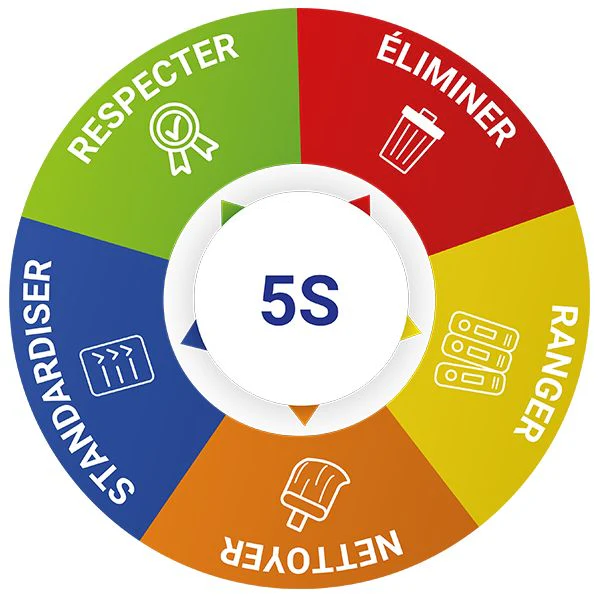
1. Visual 5S
The 5S method helps sustainably organize workstations. Its visual dimension is key:
- Floor mats and floor markings for traffic and storage areas
- Standardized labeling of locations
- Displayed cleaning and organization standards
✅ Result : a clear, logical, unambiguous space… where deviations are immediately visible.
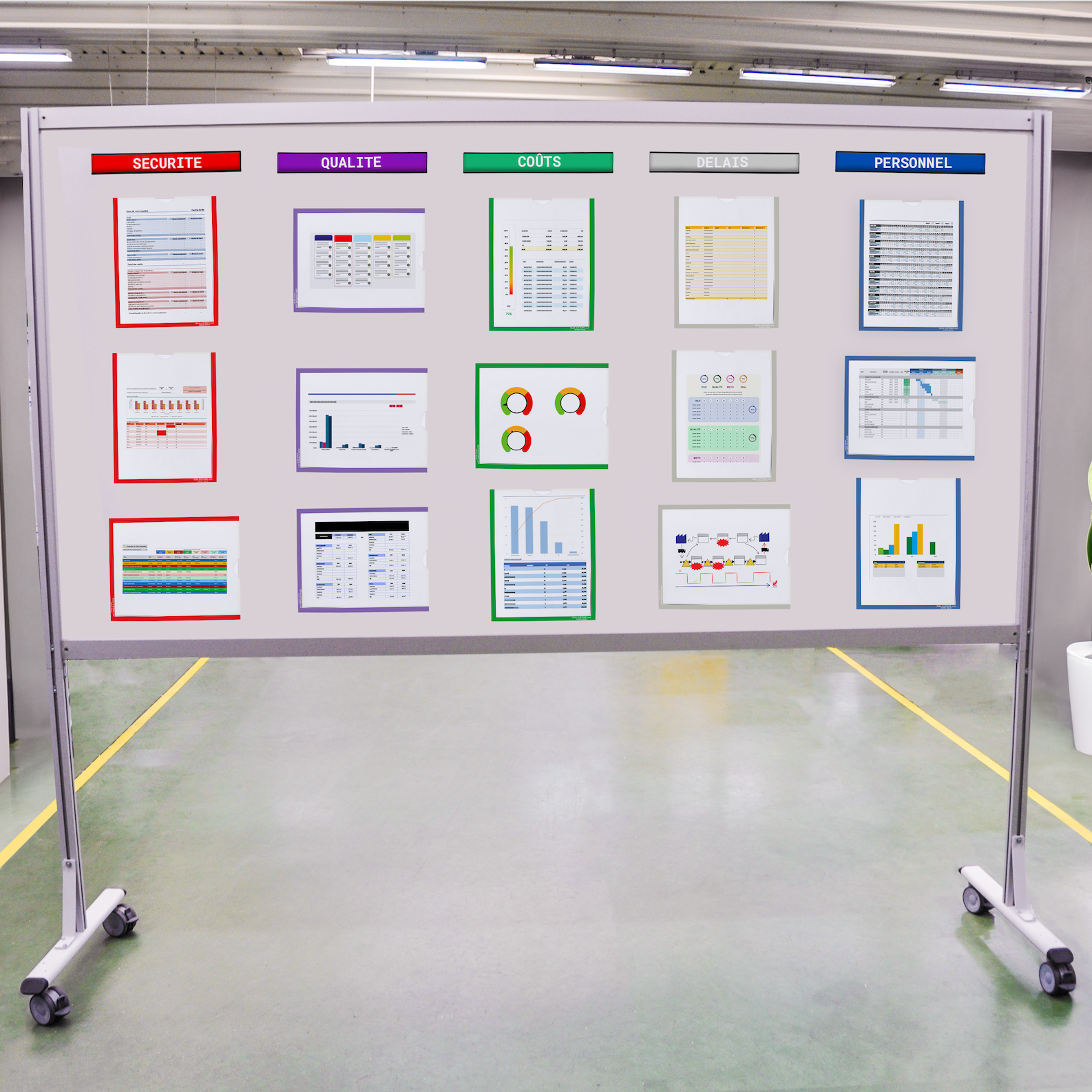
2. Indicator Boards (SQCDP, OEE, etc.)
Displayed in workshops, these boards enable daily monitoring of:
- Safety
- Quality
- Costs
- Delivery
- Productivity
These KPIs are updated visually and shared with teams in real time.
✅ Result: daily alignment on priorities and deviations.
3. Visual Management Boards
These are animation areas where teams conduct visual management rituals:
- Daily 5-minute stand-up meetings
- Ongoing actions with color-coded statuses
- Display of successes and alerts
✅ Result: stronger team dynamics and more agile management.
4. Visual Performance Audits
Conducted directly on the shop floor using visible evaluation tools (displayed checklists, tags, color scorecards):
- Compliance with standards
- Respect for flows
- Cleanliness and safety
✅ Result: rapid detection of deviations and immediate action plans.
Real-Life Example: A Production Line Transformed by Visual Management
Context : a food processing company observes productivity losses caused by unnecessary movements and poorly positioned inventory.
Implementation:
- Floor marking of storage areas
- Full 5S deployment with location labeling
- Workshop performance boards
- Visual management with 5-minute rituals
Results after 3 months:
- 25% reduction in movement
- 40% reduction in work-in-progress inventory
- +12% productivity
- Improved team motivation
Conclusion – Visual Management: A Concrete Key to Sustainable Performance
Visual management is not a gimmick: it is a performance accelerator, a shop-floor communication tool, and a powerful lever for waste reduction.
By making information accessible, visible, and actionable, it allows every operator to become an active contributor to continuous improvement.
It is a simple, low-cost, yet extremely profitable approach.


